
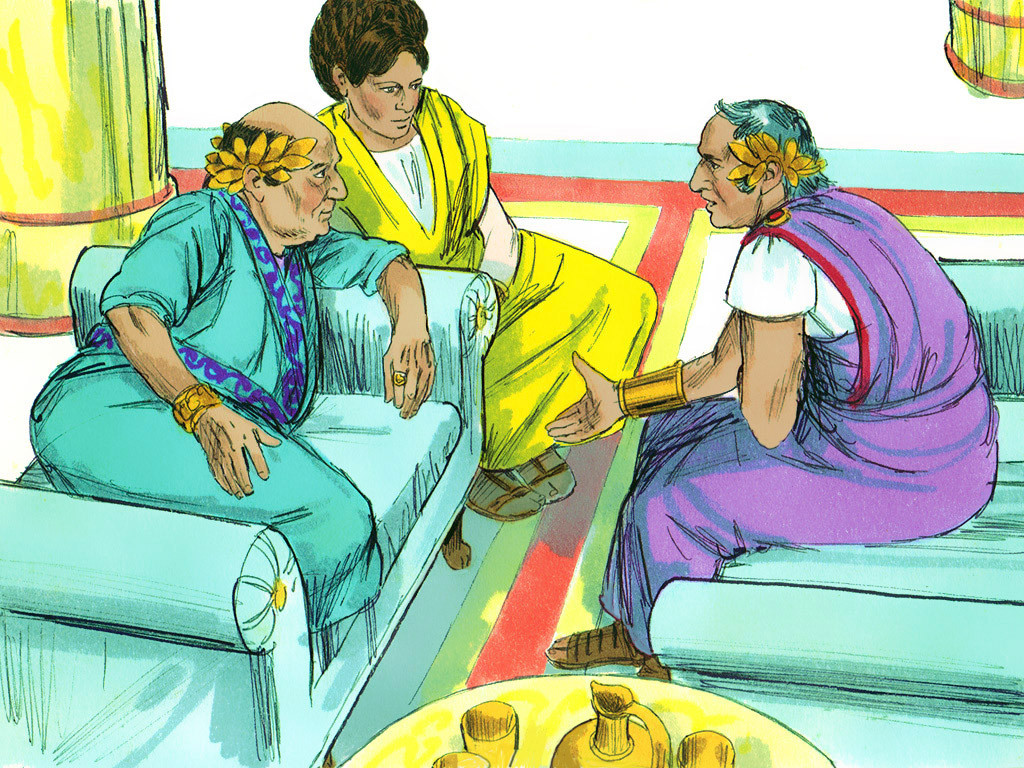
Last week we looked at Drusilla. If you have not read it, you can read it here. Today, we will be looking at her sister Bernice. Bernice has an interesting story like her sister, Drusilla. She is the eldest daughter of Herod Agrippa 1. She was married multiple times. She married her uncle Herod, king of Chalcis. After he died, many suspect that she had relations with her brother, Agrippa. She left him and married again. She later became a mistress to two Roman emperors, Vespasian and Titus.
Www.gotquestions.org tells this, “Herod Agrippa II lived with Bernice, who was herself in the Herodian line, being a daughter of Herod Agrippa I. She had been married to her uncle, Herod Pollio of Chalcis (not mentioned in Scripture), but after his death moved in with her brother, Agrippa II, in an incestuous relationship. Late in his career, Herod Agrippa II saw that tensions were rising between Rome and the Jews, and he tried unsuccessfully to prevent war. Ultimately, he sided with Rome, and he was expelled by his Jewish subjects. He lived out the rest of his life in Rome. He was the last of Herod’s line to be a king.”
We pick up her story in Acts 25:13-23 ESV] Now when some days had passed, Agrippa the king and Bernice arrived at Caesarea and greeted Festus. And as they stayed there many days, Festus laid Paul’s case before the king, saying, “There is a man left prisoner by Felix, and when I was at Jerusalem, the chief priests and the elders of the Jews laid out their case against him, asking for a sentence of condemnation against him. I answered them that it was not the custom of the Romans to give up anyone before the accused met the accusers face to face and had opportunity to make his defense concerning the charge laid against him. 17 So when they came together here, I made no delay, but on the next day took my seat on the tribunal and ordered the man to be brought. When the accusers stood up, they brought no charge in his case of such evils as I supposed. Rather they had certain points of dispute with him about their own religion and about a certain Jesus, who was dead, but whom Paul asserted to be alive. Being at a loss how to investigate these questions, I asked whether he wanted to go to Jerusalem and be tried there regarding them. But when Paul had appealed to be kept in custody for the decision of the emperor, I ordered him to be held until I could send him to Caesar.” Then Agrippa said to Festus, “I would like to hear the man myself.” “Tomorrow,” said he, “you will hear him.” So on the next day Agrippa and Bernice came with great pomp, and they entered the audience hall with the military tribunes and the prominent men of the city. Then, at the command of Festus, Paul was brought in.”
The complete interaction with Paul and Agrippa can be read in Acts 25:23-26:32.
Little is known about Bernice after this interaction. We do not know for certain what influence she may have had with her husband. Www.gotquestions.org says this about the or interaction with Paul, “Governor Festus interrupted Paul’s defense at that point, shouting, “You are out of your mind, Paul! . . . Your great learning is driving you insane” (Acts 26:24). Paul replied, “I am not insane, most excellent Festus. . . . What I am saying is true and reasonable. The king is familiar with these things, and I can speak freely to him. I am convinced that none of this has escaped his notice, because it was not done in a corner. King Agrippa, do you believe the prophets? I know you do” (verses 25–27). Then Herod Agrippa II said to Paul, “Do you think that in such a short time you can persuade me to be a Christian?” (verse 28). Paul’s reply shows the heart of an evangelist: “Short time or long—I pray to God that not only you but all who are listening to me today may become what I am, except for these chains” (verse 29). At that, the royals left the room, convinced of Paul’s innocence. Herod Agrippa II said to Festus, “This man could have been set free if he had not appealed to Caesar” (verse 32).
It is significant that Herod Agrippa II admits Paul had done nothing wrong and should by all rights be set free. With the possible exception of Herod Antipas who liked to listen to John—albeit for superstitious reasons—this is the only biblical record of a positive interaction between a Herodian king and Jesus and His church.”
The lessons from Bernice are similar to those of Drusilla. She shows us what not to do. Bernice led a sinful and promiscuous life. Don’t do that! She had the opportunity to hear the gospel from Paul. Every indication shows that he did not believe and repent.
Like Bernice and her sister, we need to believe and repent. If there is sin in our life, we need to turn away from it immediately. Don’t let sin fester and grow in your life. Deal with it immediately.
Image from www.freebibleimages.org