
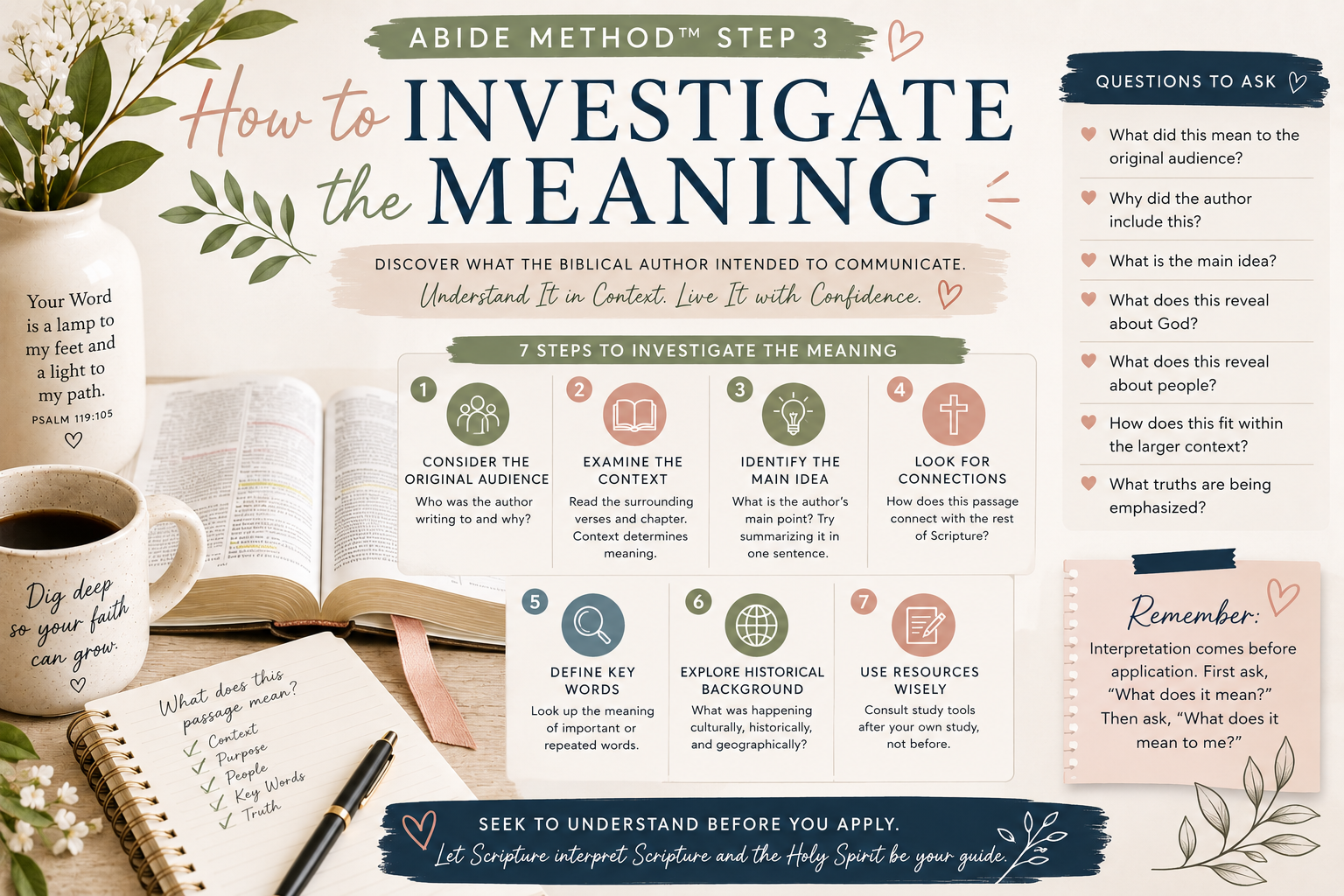
The Third Step of the ABIDE Method™
Have you ever read a passage of Scripture and thought, I understand the words, but I’m not sure I understand what this actually means?
You’re not alone.
Many women faithfully read their Bibles for years but feel uncertain when it comes to understanding Scripture. They wonder if they’re interpreting the passage correctly. They worry they’ll miss something important or arrive at the wrong conclusion.
The good news is that Bible study isn’t reserved for pastors, professors, or seminary students.
God has given His Word to His people.
And while understanding Scripture requires effort, prayer, and humility, it is not beyond your reach.
That’s why the third step of the ABIDE Method™ is:
I — Investigate the Meaning
After we have carefully observed the text, we’re ready to begin asking:
What does this passage mean?
Notice I didn’t say:
“What does this passage mean to me?”
That question comes later.
First, we need to understand what the author intended to communicate to the original audience.
Only then can we faithfully apply the truth to our lives.
Observation Comes Before Interpretation
Before we investigate the meaning, we must first behold the text.
Observation gives us the raw materials for interpretation.
When we skip observation, we often replace God’s message with our assumptions.
When we observe carefully, we build our understanding on what the text actually says.
Think of interpretation as putting together a puzzle.
Observation gathers the pieces.
Interpretation helps us see the picture.
Step 1: Ask What the Passage Meant to the Original Audience
Every book of the Bible was written by a real author to real people in a real historical setting.
One of the most important questions we can ask is:
What would the original readers have understood?
Consider:
- Who was receiving this message?
- What was happening in their lives?
- Why was the author writing?
- What issue was being addressed?
For example, Paul’s instruction to the Philippians to rejoice takes on greater meaning when we remember he was writing from prison.
Historical context often sheds light on the passage.
Step 2: Examine the Context
One of the simplest ways to avoid misunderstanding Scripture is to read it in context.
A verse should never be isolated from the surrounding passage.
Ask:
- What comes before this passage?
- What comes after it?
- How does this section fit within the chapter?
- How does the chapter fit within the book?
Sometimes a difficult verse becomes much clearer when viewed within its larger context.
A good rule of thumb is:
Context determines meaning.
Step 3: Identify the Main Idea
Every passage has a central message.
Ask yourself:
- What point is the author making?
- What truth is being emphasized?
- What is the main takeaway?
Try summarizing the passage in one sentence.
If you’re studying a paragraph, ask:
“If I could explain this section in a single sentence, what would I say?”
This exercise helps you focus on the author’s intended message rather than getting lost in small details.
Step 4: Look for Connections Within Scripture
One of the beautiful things about God’s Word is that Scripture often explains Scripture.
Ask:
- Does this passage connect to another passage?
- Is this theme discussed elsewhere?
- Are there Old Testament references?
- Does another biblical author address this same truth?
Cross-references can provide valuable insight and help us see the consistency of God’s message throughout the Bible.
Step 5: Define Important Words Carefully
Words matter.
Sometimes understanding a key word can unlock the meaning of an entire passage.
Look for:
- Repeated words
- Unfamiliar words
- Theological terms
- Words that seem central to the author’s argument
Use a reliable Bible dictionary or lexicon if needed.
But remember:
The goal isn’t to impress people with Greek or Hebrew.
The goal is to understand what God is communicating.
Step 6: Ask What This Reveals About God
The Bible is first and foremost a revelation of God.
As you investigate the meaning, ask:
- What does this passage reveal about God’s character?
- What does it teach about His purposes?
- What does it show about His faithfulness?
- What does it reveal about His holiness, love, justice, mercy, or sovereignty?
The more we understand who God is, the more clearly we understand Scripture.
Step 7: Ask What This Reveals About Humanity
The Bible not only reveals God—it reveals us.
Ask:
- What does this teach about human nature?
- What struggles do people face?
- What attitudes are exposed?
- What behaviors are commended or corrected?
Scripture often acts as a mirror, helping us see ourselves more clearly.
Step 8: Consult Trusted Resources Wisely
There is nothing wrong with using study tools.
In fact, they can be incredibly helpful.
But I encourage women to develop a simple habit:
Study first. Research second.
Spend time making your own observations and conclusions before turning to outside resources.
Then use tools such as:
- Study Bibles
- Bible dictionaries
- Commentaries
- Bible handbooks
These resources should support your study, not replace it.
The goal is not dependence on experts.
The goal is growing confidence in handling God’s Word for yourself.
Questions to Ask While Investigating the Meaning
Keep these questions nearby as you study:
- What did this mean to the original audience?
- Why did the author include this?
- What is the main idea?
- What does this reveal about God?
- What does this reveal about people?
- How does this fit within the surrounding context?
- What truths are being emphasized?
- What connections exist elsewhere in Scripture?
These questions help us move beyond surface reading and into deeper understanding.
Common Mistakes to Avoid
Jumping Straight to Application
Application matters, but application built on misunderstanding can lead us astray.
Always ask what the passage means before asking how it applies.
Ignoring Context
Many misunderstandings happen when verses are removed from their context.
Read broadly before drawing conclusions.
Depending Entirely on Other People’s Interpretations
Commentaries are helpful.
Teachers are valuable.
But God desires for you to engage with His Word personally.
You can learn from others without becoming dependent upon them.
A Final Encouragement
Friend, investigating the meaning isn’t about becoming a Bible expert.
It’s about becoming a faithful student of God’s Word.
You don’t need advanced degrees.
You don’t need years of formal training.
You simply need a willing heart, a curious mind, and a commitment to slow down long enough to ask good questions.
As you practice this step, you’ll begin to notice connections you once missed.
You’ll see themes woven throughout Scripture.
You’ll gain confidence in understanding God’s Word.
And perhaps most importantly, you’ll discover that Bible study isn’t about finding hidden secrets.
It’s about learning to listen carefully to what God has already said.
The Lord delights in revealing Himself through His Word.
As you investigate the meaning, may your understanding deepen, your confidence grow, and your love for God flourish.
Because the goal of Bible study isn’t merely information.
It’s transformation through the truth of God’s Word.
Want to know more? Download my FREE Bible Study Starter Kit and learn the ABIDE Method™.
🌿 Get My Free Starter Kit