
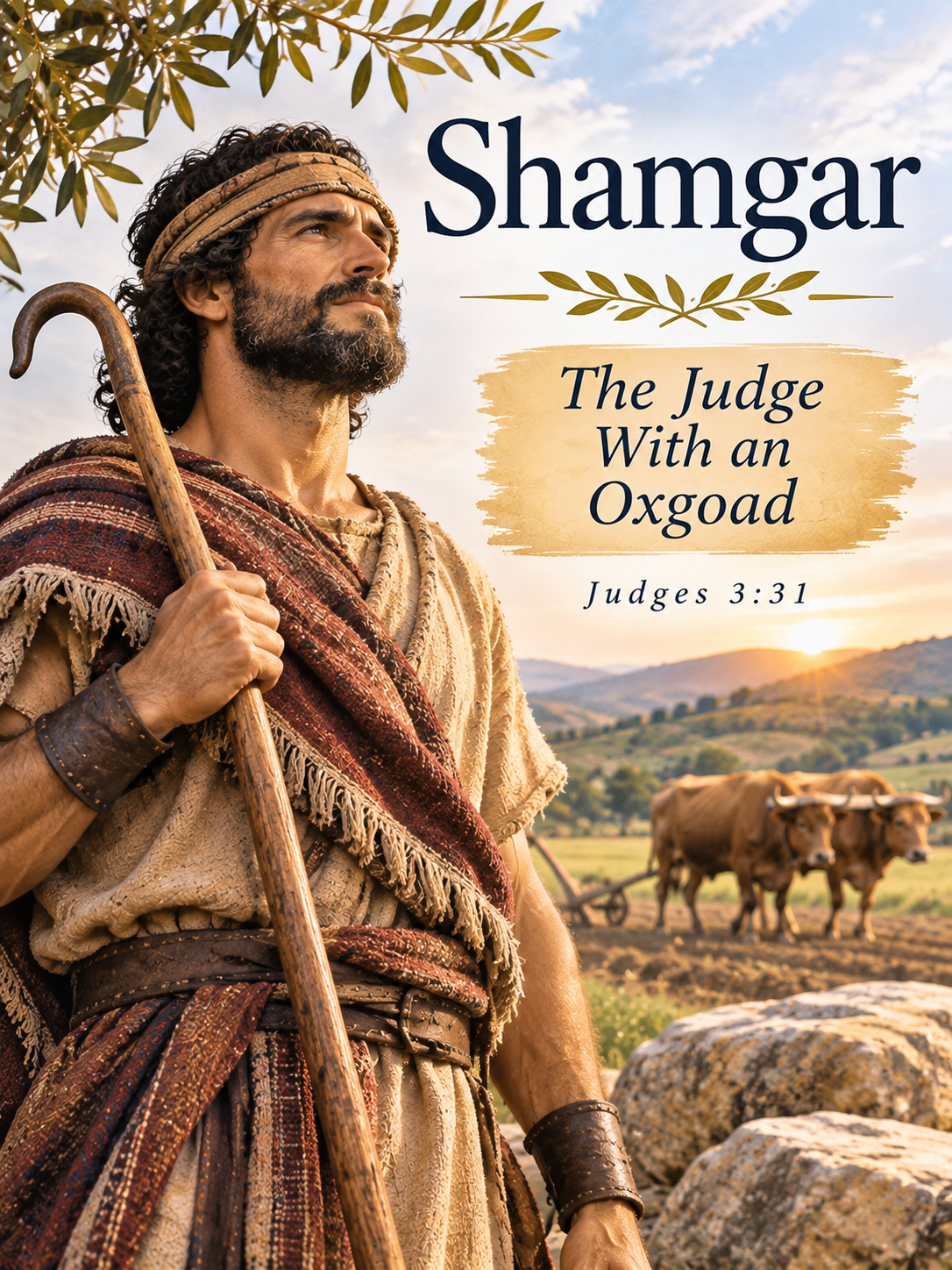
Have you ever hurried through a passage of Scripture because it seemed too short to contain anything meaningful? You open your Bible, read a verse or two, and move on to the next chapter. There are no lengthy conversations, no dramatic speeches, and no detailed account of what happened. Just a name, a brief description, and a few words about what someone did.
It can be tempting to think there isn’t much to discover. But what if the passages we are most tempted to skip are the very ones that teach us to become more careful students of God’s Word? That is exactly what we discover when we meet Shamgar, one of the lesser-known judges of Israel.
His story is recorded in just one verse in Judges 3:31, with another brief reference in the Song of Deborah in Judges 5:6. We know very little about his life, yet Scripture preserves his name and tells us about an act of deliverance that made a difference for Israel.
Shamgar reminds us that we do not need a long passage to begin asking meaningful questions. Sometimes a single verse is an invitation to slow down, look closely, and appreciate what God has chosen to preserve in His Word.
Let’s take a closer look at this overlooked judge and discover what his brief story can teach us about Bible study, courage, and God’s work in the history of His people.
Who Was Shamgar?
Judges 3:31 gives us this account:
“After him was Shamgar the son of Anath, who killed 600 of the Philistines with an oxgoad, and he also saved Israel.”
That is the substance of the entire verse. No lengthy introduction. No description of his calling. No account of his childhood or family life. No record of a speech or a battle plan. We are simply told that Shamgar was the son of Anath, that he killed six hundred Philistines with an oxgoad, and that he saved Israel. An oxgoad was a long, sturdy implement used to guide or drive oxen while plowing. It was an agricultural tool, not a weapon designed for military combat.
It is a remarkable statement, especially when we consider how little information accompanies it. Yet the passage tells us that Shamgar used this implement against the Philistines and that he delivered Israel.
The account does not tell us whether this happened in one encounter or across a series of confrontations. It does not describe the precise circumstances of the conflict. We should resist the temptation to supply those details ourselves.
What we can say is that Scripture attributes a significant act of deliverance to a man who used an unexpected instrument. And that is enough to make us stop and pay attention.
1. A Short Story Can Contain Important Truth
One of the first things I notice about Shamgar is how little Scripture tells us about him. We are given one verse, yet that verse contains a name, a family designation, a number, an unusual implement, an enemy, and a statement about deliverance. Every one of those details gives us something to observe.
This is where good Bible study begins. Before we rush to explain a passage or decide what it means for our lives, we need to take time to notice what is actually there. Who is mentioned? What happened? What details stand out? What words are used? How does this passage connect to the surrounding chapters?
When we slow down enough to ask those questions, even a short verse becomes an opportunity to study carefully.
Consider the number Scripture gives us: six hundred. Consider the oxgoad. Consider the identification of the Philistines as the people Shamgar fought. And consider the concluding statement that he saved Israel.
The author could have simply mentioned Shamgar’s name and moved on. Instead, the account preserves specific details about his action.
We may not know everything we would like to know, but we know enough to recognize that his role mattered. This is an important lesson for us as Bible students. We do not need to know every detail of a person’s life to learn from what Scripture does tell us.
We must learn to value the information God has given us rather than becoming frustrated by the information He has not given us.
Try This in Your Own Bible Study
The next time you come across a short passage, resist the urge to move on immediately.
Read it several times. Write down the facts you can observe without interpreting them yet. Then ask what questions the passage raises. Finally, look at the surrounding context to see how the passage fits into the larger story.
You may discover that careful observation gives you more to consider than you initially expected.
2. Shamgar Used an Unexpected Instrument
There is something striking about the mention of an oxgoad. It was an ordinary agricultural implement. It was not the weapon we might expect to read about in an account of military deliverance. Yet it is the detail that makes Shamgar’s story so memorable.
The text does not explain why he used an oxgoad or whether other weapons were available to him. We should not pretend to know those things. But we can observe the contrast between the tool itself and the result described in the passage. An oxgoad was associated with ordinary work. Shamgar’s action, however, was associated with the deliverance of Israel from its enemies.
The contrast invites us to think carefully about how God works throughout Scripture.
God often accomplishes His purposes through people and circumstances that do not match our expectations. Moses carried a staff. David faced Goliath with a sling and stones. Gideon led an army that God deliberately reduced to three hundred men.
Each of those accounts has its own historical context, and we should not assume that all the stories teach precisely the same lesson. But together they remind us that God’s purposes are not dependent on the impressive resources people might expect. Shamgar’s story gives us another example of an unexpected instrument appearing in an account of deliverance.
What matters most is not whether we can turn his oxgoad into a universal formula for our own lives. It is that we pay attention to the way the biblical narrative describes what happened.
What Might This Teach Us Today?
We sometimes assume that meaningful service requires special qualifications, extraordinary resources, or a position of influence. We may look at our own lives and think we have little to offer. Perhaps we do not have extensive biblical knowledge yet. Perhaps we are not natural teachers or public speakers. Perhaps the opportunities before us seem small compared with what others are doing.
Shamgar’s story encourages us to reconsider our assumptions about what makes a story significant. The passage does not give us a formula promising that God will use every ability or resource in a particular way. But it does remind us that ordinary objects and seemingly unexpected circumstances can play a role in events far greater than we might anticipate. Rather than comparing our resources with someone else’s, we can ask a more helpful question:
What faithful step can I take with what God has placed before me?
That might mean learning to study Scripture more carefully, encouraging a woman who is struggling, serving faithfully in your church, or using your creative gifts to help someone else engage with God’s Word.
We do not have to make our contribution look impressive. We need to approach the opportunities before us with humility, wisdom, and faithfulness.
3. Shamgar’s Story Connects to a Larger Season in Israel’s History
Although Judges 3:31 is brief, Shamgar is mentioned again in Judges 5:6.
This second reference appears in the Song of Deborah, a poetic account celebrating the Lord’s victory over Israel’s enemies.
Judges 5:6 refers to the days of Shamgar son of Anath and the days of Jael. It describes a time when roads were abandoned and travelers took winding paths. That detail is important. The verse gives us a glimpse of insecurity and disruption in the land. Ordinary travel had become difficult, and the description suggests that life was not proceeding under peaceful conditions.
We should be cautious about drawing conclusions beyond what the text supports. The verse does not explain every event during Shamgar’s time or establish a complete timeline of his life. But it does place his name within a broader account of difficult circumstances in Israel.
Reading the two references together helps us understand why cross-referencing is such a valuable Bible study skill. If we read only Judges 3:31, we know that Shamgar delivered Israel from the Philistines. When we also read Judges 5:6, we discover that his name appears in another passage describing a troubled period in Israel’s history. One verse does not answer every question, but the second reference adds context.
This is why I encourage women to pay attention to cross-references, repeated names, and related passages when studying Scripture. The Bible is not a collection of unrelated sayings. Its books contribute to a larger story, and careful reading helps us see how individual passages fit within that story.
A Simple Bible Study Exercise
Read Judges 3:31 and Judges 5:6 side by side.
Ask yourself:
- What information appears in both passages?
- What additional detail do you learn from Judges 5:6?
- What do the verses actually tell you about Shamgar?
- What questions remain unanswered?
- How does reading both passages improve your understanding?
This is a simple exercise, but it demonstrates how one additional reference can deepen our understanding without requiring us to speculate.
4. What Does Shamgar’s Story Teach Us About Faithfulness?
Because Shamgar’s account is so brief, we need to be careful when describing his character.
Scripture does not tell us what his private devotional life was like. It does not record his prayers, explain his motivations, or describe his relationship with God in the way it does for some other biblical figures. We cannot confidently fill in those missing details.
What the text does tell us is that Shamgar performed an act through which Israel was delivered from its enemies. His name was preserved in the biblical record, and his action became part of Israel’s history. That is enough to make his story worth studying.
Sometimes we want Scripture to tell us more than it does. We want to know what a person thought, how they felt, what they said, and what happened afterward. But learning to study the Bible well includes learning where to stop. We can appreciate what Scripture reveals without inventing a fuller biography for someone whose story is brief.
This is an important distinction between biblical reflection and speculation.
Reflection asks, “What can I learn from what the text actually says?”
Speculation says, “I wonder whether this person must have felt or experienced something the text never mentions.” There is nothing wrong with recognizing questions that a passage leaves unanswered. In fact, those questions can help us identify areas for further study. The key is to keep our conclusions anchored in Scripture.
Shamgar’s story reminds us that a person’s significance in the biblical narrative is not measured by the number of verses devoted to them. A short account can still be important. An unfamiliar name can still belong to a meaningful moment in God’s unfolding purposes.
A passage that initially appears insignificant can become an opportunity to practice careful observation.
5. Why We Should Not Skip the Lesser-Known People in Scripture
Most of us can name several familiar Bible characters.
We remember Moses leading Israel out of Egypt, David facing Goliath, and Daniel in the lions’ den. We know the stories of Deborah, Gideon, and Samson. But the Bible also includes people whose stories are recorded in only a few verses. Some appear in genealogies. Others are mentioned in passing. Some play a significant role in an event but receive little personal introduction.
Shamgar belongs to this group. His account challenges us to think about how we approach the Bible.
Do we slow down when a story is familiar, or do we assume we already know what it says?
Do we pay attention to details, or do we read quickly to reach the next familiar passage?
Do we allow the text to guide our conclusions, or do we bring assumptions to it without examining them?
These questions matter because Bible study is not simply about collecting information. It is about learning to understand what God has revealed in His Word. When we read carefully, we develop habits that help us interpret longer and more complicated passages, too. We learn to distinguish observation from interpretation. We become more attentive to historical context. We learn to compare related passages and recognize the limits of what we can conclude.
In that sense, studying Shamgar is not merely an exercise in learning about a lesser-known judge. It is an opportunity to become a better student of Scripture. That is a lesson worth carrying into every book of the Bible.
Study Shamgar’s Story for Yourself
If you have a few minutes today, open your Bible to Judges 3:31.
Read the verse slowly. Then turn to Judges 5:6 and read that verse in its surrounding context.
As you study, use these questions to guide your observations.
Behold the Text — What do you see?
- What details does Judges 3:31 give about Shamgar?
- What implement did he use?
- How many Philistines does the passage say he killed?
- What does the verse say happened as a result?
- What additional information appears in Judges 5:6?
Investigate the Meaning — What can you understand?
- Why might the author have included the detail about the oxgoad?
- How does Judges 5:6 add context to your reading of Judges 3:31?
- What does the passage reveal about the circumstances in Israel during this period?
- Which questions about Shamgar remain unanswered by the text?
Embrace the Truth — How will you respond?
- Do you tend to overlook short or unfamiliar passages?
- What Bible study habit could help you pay closer attention to Scripture?
- How can you become more careful about distinguishing what the Bible says from what you assume it says?
Take time to write down your answers. You do not have to find a dramatic application for every verse. Sometimes the most valuable result of a study is a clearer understanding of what the passage means and how it fits into Scripture.
A Final Thought: Don’t Overlook the Small Stories
Shamgar’s story occupies just one verse in Judges 3, with another brief mention in Judges 5. We know very little about his life, yet Scripture has preserved his name and his role in Israel’s history.
That alone gives us a reason to pause.
We do not need to invent details about Shamgar or turn his story into a formula for our own lives. We can simply read what Scripture says, consider it in context, and appreciate its place in the larger biblical narrative.
As you continue studying God’s Word, I encourage you not to measure a passage’s value by its length.
The short verses matter. The unfamiliar names matter. The details we are tempted to skip may help us understand the passage more clearly.
So the next time you reach a verse that seems too brief to study, stop for a moment.
Read it again. Ask a question. Look for a connection. Write down what you observe.
You may discover that careful Bible study begins not with knowing all the answers, but with being willing to pay attention.
Happy studying!
Mary
Mary’s Musings
Let me know what you think.