
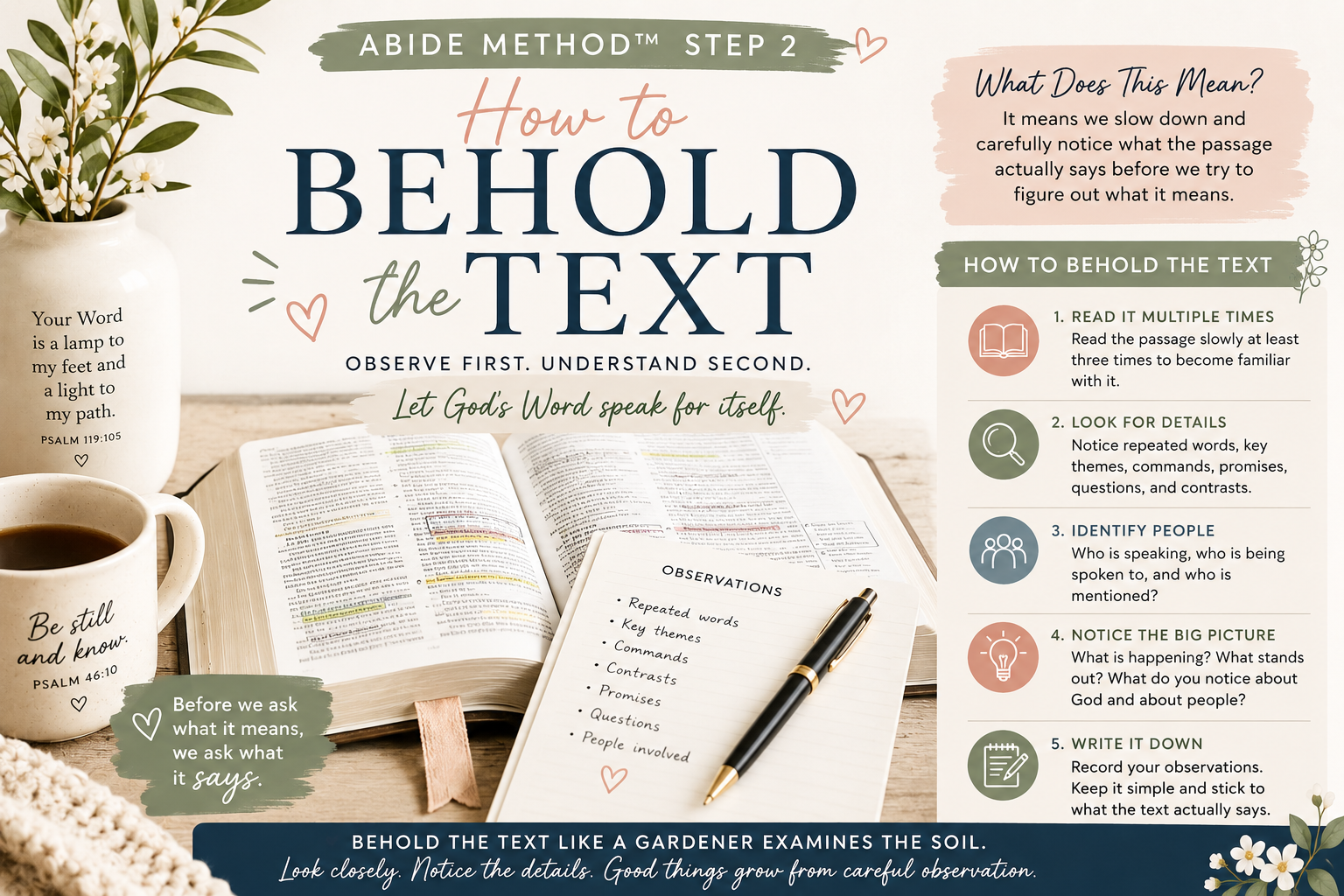
The Second Step of the ABIDE Method™
One of the biggest mistakes we make when studying Scripture is rushing ahead to ask, “What does this mean?” before we’ve taken time to notice what the text actually says.
I’ve done it myself.
We read a verse, recognize a familiar phrase, and immediately jump to interpretation. We search for a commentary, read a devotional, or listen to someone else’s teaching before we’ve spent time observing God’s Word with our own eyes.
But before we investigate the meaning, we need to learn to behold the text.
That’s why the second step of the ABIDE Method™ is:
B — Behold the Text
To behold means more than simply reading. It means slowing down, paying attention, and carefully observing what God has placed in His Word.
Think of it as the difference between glancing at a painting and standing before it long enough to notice the details.
The goal of this step is not interpretation.
The goal is observation.
Before we ask what the text means, we ask:
What do I see?
Why Observation Matters
When we rush past observation, we often miss the very details God inspired the biblical authors to include.
The repeated words.
The contrasts.
The commands.
The promises.
The questions.
The emotions.
The connections.
Observation helps us move from simply reading Scripture to truly engaging with it.
The more carefully we observe, the more accurately we can interpret.
Step 1: Read the Passage Multiple Times
Start by reading the passage slowly several times.
I recommend reading it at least three times.
First Reading
Read for familiarity.
Simply take in the passage.
Don’t worry about taking notes yet.
Second Reading
Read more slowly.
Begin noticing details that stand out.
Third Reading
Read with a pen in hand.
Mark observations as you go.
Many women are surprised by how much they notice on the third reading that they completely missed on the first.
Step 2: Look for Repeated Words and Ideas
Biblical writers often emphasize important truths through repetition.
Ask yourself:
- What words appear more than once?
- What ideas keep surfacing?
- What themes seem important?
For example, while studying Philippians, you may notice repeated references to joy and rejoicing.
That repetition is a clue that joy is an important theme of the book.
Repeated words often reveal the author’s focus.
Step 3: Identify Key People
Ask:
- Who is speaking?
- Who is being addressed?
- Who is mentioned?
Pay attention to names, groups of people, and references to God.
Understanding who is involved helps you follow the flow of the passage.
Step 4: Notice Commands
Commands often reveal how God desires His people to live.
Look for words such as:
- Do
- Go
- Remember
- Rejoice
- Pray
- Trust
- Put on
- Put away
Mark them in your Bible or notebook.
Ask:
What is God calling His people to do?
Step 5: Look for Contrasts and Comparisons
Writers frequently teach through contrast.
Watch for words like:
- But
- Yet
- However
- Rather
- Instead
Also notice comparisons using words such as:
- Like
- As
- Just as
These connecting words often reveal important relationships within the text.
Step 6: Notice Cause-and-Effect Relationships
Pay attention to words such as:
- Therefore
- Because
- Since
- For
- So that
These words help us understand why something is true or what result follows.
Whenever you see “therefore,” ask:
What is it there for?
The answer usually points back to an important truth the author has already explained.
Step 7: Observe What the Passage Teaches About God
This may be the most important observation you make.
Ask:
- What does this passage reveal about God’s character?
- What does it teach about His actions?
- What does it reveal about His promises?
- What does it show about His purposes?
The Bible is ultimately God’s story.
Learning to see Him in the text transforms Bible study from an academic exercise into an act of worship.
Step 8: Observe What the Passage Teaches About People
Ask:
- What does this reveal about human nature?
- What struggles do people face?
- What attitudes are exposed?
- What responses are commended or corrected?
Scripture helps us understand both God and ourselves.
Step 9: Record Your Observations
Write down what you notice.
Keep observations separate from interpretation.
For example:
Observation:
“The word ‘joy’ appears four times in this chapter.”
Interpretation:
“Paul is emphasizing that joy is not dependent upon circumstances.”
Observation comes first.
Interpretation comes later.
This discipline helps us remain faithful to the text.
Questions to Ask While Beholding the Text
As you read, keep these questions nearby:
- What stands out?
- What is repeated?
- Who is involved?
- What commands are given?
- What promises are made?
- What contrasts appear?
- What does this teach about God?
- What does this teach about people?
- What emotions are expressed?
- What questions does this raise?
You don’t need to answer every question every time.
Use them as tools to help you slow down and notice.
A Final Encouragement
Friend, you do not need a seminary degree to observe Scripture well.
You simply need time, patience, and a willingness to look closely.
The Holy Spirit delights in helping God’s children understand His Word.
The more you practice observing Scripture, the more you’ll begin to notice details you once overlooked.
You’ll see themes connecting across chapters.
You’ll recognize patterns.
You’ll discover truths for yourself.
And that confidence is exactly what we’re building through the ABIDE Method™.
Before we can investigate the meaning, we must first behold the text.
So slow down.
Read carefully.
Notice what God has placed before you.
His Word has more to say than we often realize when we rush past it.
And sometimes the deepest discoveries begin with simply paying attention.
Want to see more? Download the freebie for the ABIDE METHOD
Download my FREE Bible Study Starter Kit and learn the ABIDE Method™.
🌿 Get My Free Starter Kit