
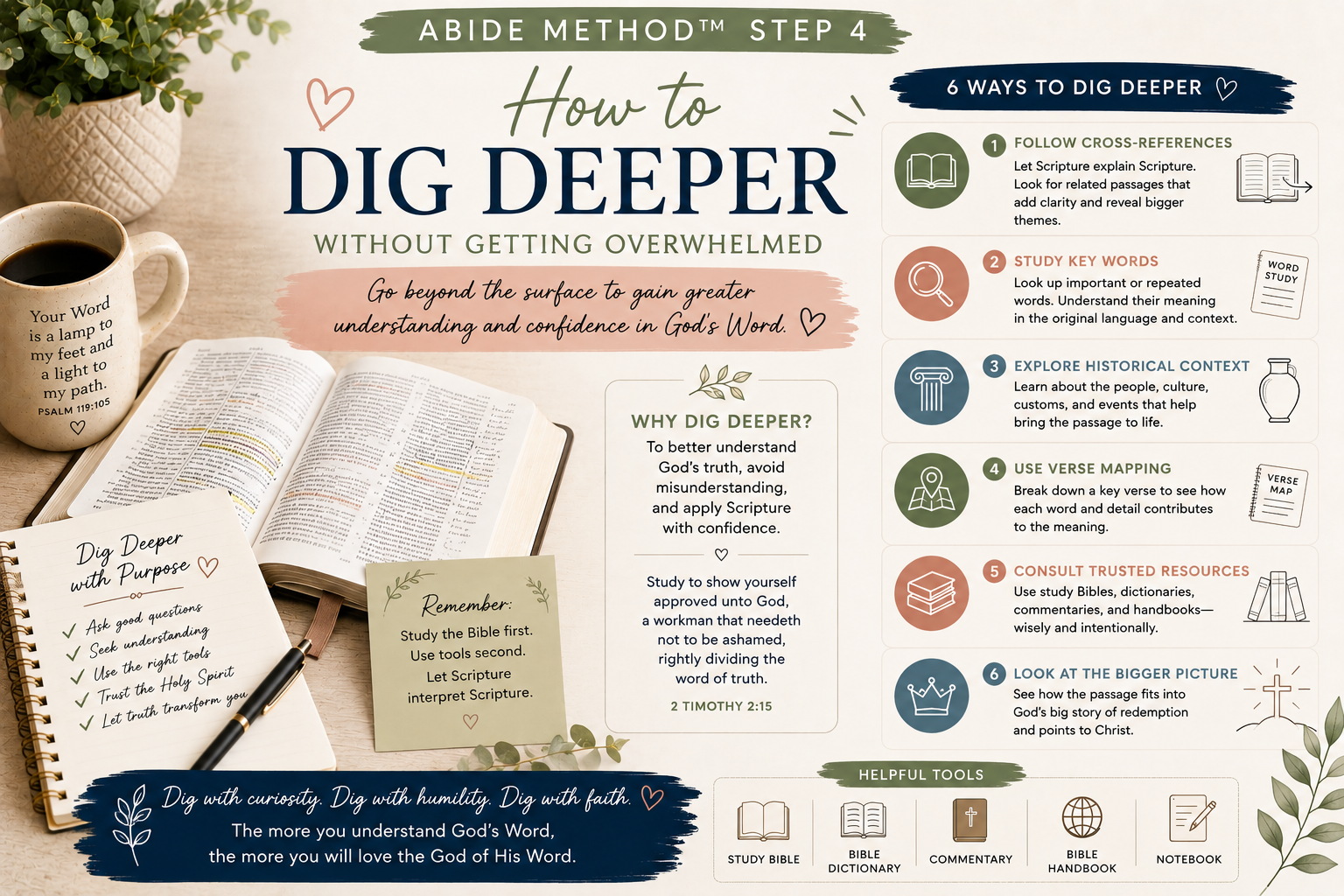
The Fourth Step of the ABIDE Method™
Have you ever opened a Bible study resource and immediately felt overwhelmed?
Maybe you started looking up cross-references and ended up chasing rabbit trails for an hour.
Perhaps you opened a commentary only to find pages of information that left you more confused than when you started.
Or maybe you’ve looked at all the Bible study tools available today and thought:
“Where do I even begin?”
If that’s you, you’re not alone.
Many women want to go deeper in their Bible study but feel intimidated by the sheer amount of information available. They worry they don’t know enough. They wonder which tools they should use and whether they’re using them correctly.
The good news is that digging deeper doesn’t have to be complicated.
In fact, one of the biggest lessons I’ve learned over the years is this:
You do not need more information. You need a simple process.
That’s why the fourth step of the ABIDE Method™ is:
D — Dig Deeper
After we’ve observed the text and investigated its meaning, we can begin exploring the passage more fully through study tools and additional research.
The goal isn’t to collect information.
The goal is to better understand God’s Word.
What Does It Mean to Dig Deeper?
Digging deeper means taking a closer look at the details that help illuminate the passage.
It’s moving beyond the surface without becoming lost in the weeds.
Think of it this way:
When you first read a passage, you’re viewing a landscape from a distance.
When you dig deeper, you begin noticing the individual flowers, pathways, and details that make the landscape even more beautiful.
You’re not changing the meaning of the passage.
You’re gaining a fuller understanding of it.
A Word of Caution Before We Begin
Many Bible students make one of two mistakes.
Some never dig deeper at all.
They read quickly and move on.
Others spend so much time researching that they never actually engage with Scripture itself.
Neither extreme is helpful.
Remember:
The Bible is your primary source.
Study tools are secondary.
The purpose of study tools is to help you understand the text—not replace it.
Always start with Scripture.
Then use tools to support your study.
Step 1: Follow Cross-References
One of the simplest ways to dig deeper is to let Scripture explain Scripture.
Most Bibles include cross-references in the margins or footnotes.
These references point you to related passages.
As you follow them, ask:
- Does this passage repeat a theme?
- Does it clarify a difficult concept?
- Does it reveal a larger biblical pattern?
Often you’ll discover that a truth introduced in one passage is developed throughout Scripture.
The Bible is remarkably interconnected.
Cross-references help us see those connections.
Step 2: Study Key Words
Not every word needs a detailed study.
Focus on words that are:
- Repeated
- Central to the passage
- Difficult to understand
- Theologically significant
Ask questions such as:
- How is this word used elsewhere in Scripture?
- What does it mean in this context?
- Why did the author choose this word?
Sometimes a simple word study can shed light on the author’s intended message.
But remember:
The goal isn’t to impress people with what you’ve learned.
The goal is to understand God’s Word more clearly.
Step 3: Explore Historical Context
The Bible was written in a specific time and place.
Understanding some of that background can help bring a passage to life.
You might explore:
- The city where the events occurred
- Cultural customs
- Historical events
- Religious practices
- Geographic locations
You don’t need to become a historian.
Just enough context to help you better understand the original audience and circumstances.
Step 4: Use Verse Mapping Strategically
Verse mapping can be a wonderful tool when used intentionally.
Choose one verse that stands out and examine it carefully.
Look at:
- Important words
- Cross-references
- Context
- Related themes
- What the verse reveals about God
Verse mapping slows us down and helps us notice details we might otherwise overlook.
It encourages thoughtful study without requiring complicated techniques.
Step 5: Consult Trusted Resources
Once you’ve spent time studying on your own, it can be helpful to compare your observations with trusted teachers and resources.
Consider using:
- Study Bibles
- Bible dictionaries
- Bible handbooks
- Commentaries
Notice the order.
Study first.
Research second.
One of the greatest gifts you can give yourself is learning to engage the text before looking for someone else’s interpretation.
Over time, this builds confidence and discernment.
Step 6: Look for the Bigger Biblical Story
Every passage fits within God’s larger story of redemption.
As you study, ask:
- How does this point to God’s character?
- How does this connect to His covenant promises?
- How does this fit into the story of redemption?
- How does this point toward Christ?
The more we understand the Bible as one unified story, the richer our study becomes.
How to Avoid Information Overload
Let’s be honest.
It’s possible to spend hours researching and still feel stuck.
If you often feel overwhelmed, these simple guidelines may help.
Limit Your Resources
Choose one or two trusted resources rather than consulting ten different opinions.
More information doesn’t always lead to greater understanding.
Focus on One Question at a Time
Instead of trying to answer everything, identify the next question that needs an answer.
Small steps often lead to deeper understanding than frantic searching.
Keep Returning to the Text
Whenever you feel lost, return to the passage itself.
Read it again.
God’s Word should remain at the center of your study.
Remember Your Goal
The goal is not mastering every detail.
The goal is knowing God more deeply through His Word.
That perspective changes everything.
Questions to Ask While Digging Deeper
As you study, consider asking:
- What additional information would help me understand this passage?
- Are there cross-references I should explore?
- Are there key words worth studying?
- What historical context might be helpful?
- How does this fit into the larger story of Scripture?
- What does this reveal about God?
You don’t need to ask every question every time.
Use them as tools rather than rules.
You Don’t Have to Know Everything
Friend, one of the most freeing truths I’ve learned is this:
You don’t have to understand everything in order to understand something.
God’s Word is deep enough that we’ll spend a lifetime exploring it.
There will always be more to learn.
There will always be another connection to discover.
Another insight to uncover.
Another truth to treasure.
That’s not a reason to feel discouraged.
It’s an invitation to keep growing.
Bible study is not a race to master Scripture.
It’s a lifelong journey of knowing God.
A Final Encouragement
If you’ve ever felt overwhelmed by Bible study, take heart.
You don’t need dozens of tools.
You don’t need advanced training.
You don’t need all the answers.
You simply need a willingness to take the next step.
Observe carefully.
Investigate thoughtfully.
Dig deeper when appropriate.
Then trust God to continue teaching you through His Word.
The goal isn’t to become an expert.
The goal is to become a faithful student of Scripture.
And as you continue digging deeper, you’ll discover something beautiful:
The more you learn about God’s Word, the more you learn about God Himself.
And there is no greater treasure than that.
Download my FREE Bible Study Starter Kit and learn the ABIDE Method™.
🌿 Get My Free Starter Kit