
There is something beautiful about a woman longing to draw closer to Jesus.
Maybe that is what first drew you to Jesus Calling. Perhaps you were looking for a few quiet moments in the morning. Maybe you wanted encouragement for a difficult season. Or perhaps you simply wanted to feel closer to Jesus and hear His voice in the middle of an ordinary day.
That desire—to know Jesus more deeply—is a good desire.
But good desires can sometimes lead us toward resources that we need to examine carefully.
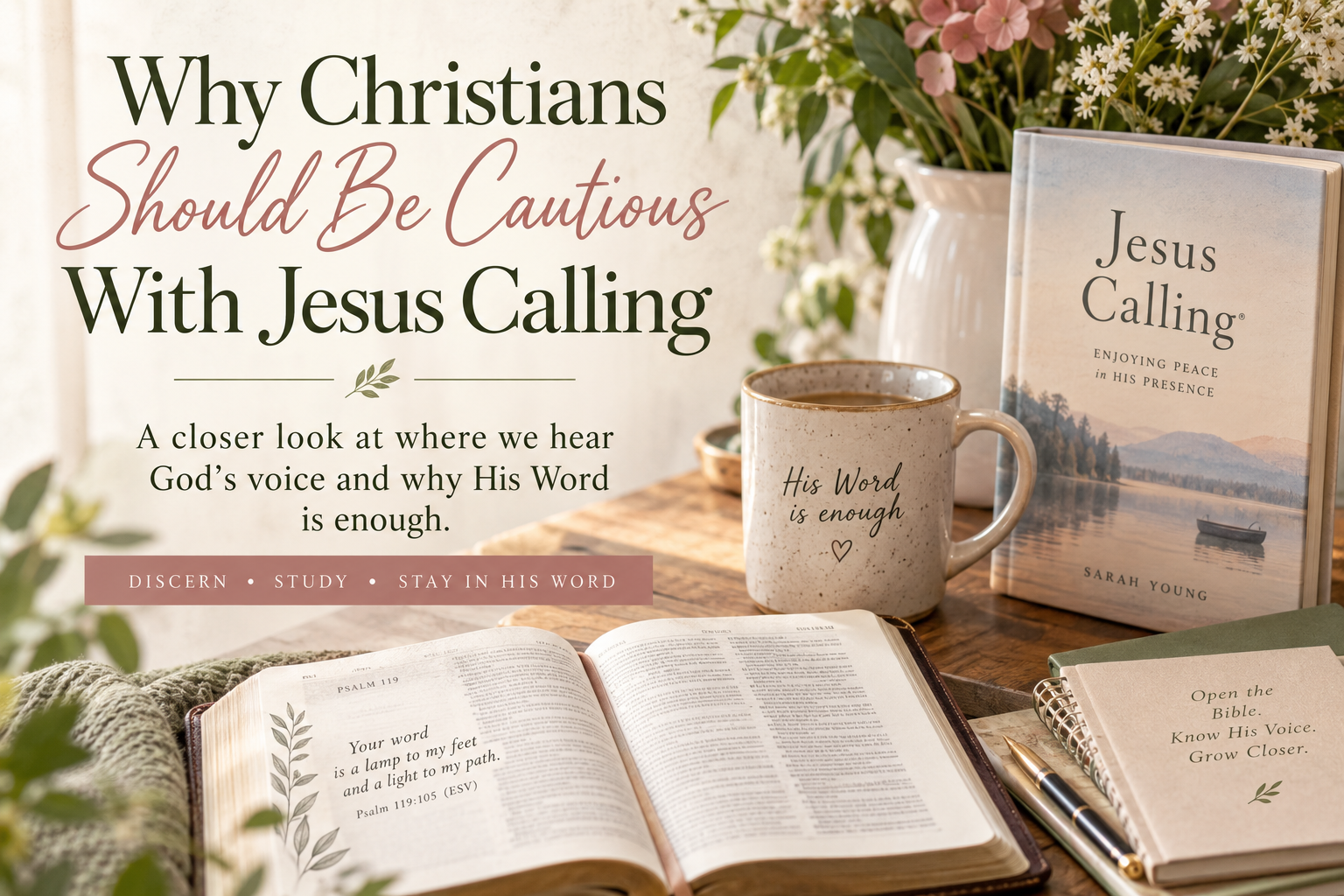
Jesus Calling, written by Sarah Young, has become one of the most widely read Christian devotionals of recent decades. Its words are warm, personal, and comforting. The devotional is written in the first person, as though Jesus Himself is speaking directly to the reader.
And that is where I believe we need to slow down.
Not because we should be afraid of every devotional book or suspicious of every Christian writer. And certainly not because I believe we should question the sincerity of every person who has found comfort in this book.
Rather, we should ask a simple but important question:
When I want to hear Jesus, where has He told me to listen?
Scripture gives us a remarkably clear answer.
We listen to Him through His Word.
That matters because the closer we want to grow to Jesus, the more carefully we should guard the difference between what God has actually said and what someone believes God might be saying.
1. God’s Word Is Sufficient
Paul tells Timothy:
“All Scripture is breathed out by God and profitable for teaching, for reproof, for correction, and for training in righteousness.”
— 2 Timothy 3:16, ESV
And then he explains why:
“that the man of God may be complete, equipped for every good work.”
— 2 Timothy 3:17, ESV
Read that again slowly. Scripture is God-breathed. Scripture teaches us.Scripture corrects us. Scripture trains us. And Scripture equips us.
The Bible does not present itself as merely one source among many that can help us discover what God wants us to know. It presents God’s Word as the authoritative standard by which we understand Him, evaluate teaching, and live faithfully.
This is why I become uncomfortable when a devotional places newly written words in the voice of Jesus.
Even when the author makes it clear that the words are not Scripture, the format creates an important question:
What happens when words that sound like Jesus are placed on the page beside the words Jesus has actually given us?
That distinction matters.
There is a profound difference between saying,
“As I read this passage, I am reminded that Jesus is faithful to me,”
and saying,
“Jesus is saying to you, I am faithful to you…”
The first points us back to Scripture.
The second asks us to receive additional words as though they came directly from Christ.
For me, that is not a distinction we should take lightly.
Our desire to hear Jesus should never become a reason to blur the line between Scripture and personal reflection.
2. We Are Told to Test What We Hear
One of the most loving things Scripture teaches us is that we don’t have to accept every spiritual-sounding message simply because it sounds comforting.
John writes:
“Beloved, do not believe every spirit, but test the spirits to see whether they are from God.”
— 1 John 4:1, ESV
Notice that John doesn’t tell believers to accept a message because it feels encouraging.
He tells us to test it. That means we need to become women who know God’s Word well enough to recognize when something doesn’t line up with it. This is one reason I believe learning how to study Scripture for ourselves is so important.
If we don’t know what the Bible says, we can easily begin measuring truth by how something makes us feel.
And comforting words can be especially difficult to evaluate. A sentence can make us feel seen. It can make us feel loved. It can bring tears to our eyes. It can sound exactly like something we desperately needed to hear. But none of those things determine whether the words are actually from Jesus.
Comfort is not the same thing as biblical authority.
That’s why Scripture—not our feelings, not a devotional writer, and not someone else’s personal experience—must remain our measuring stick.
3. There Is a Difference Between Scripture and Personal Impressions
This is where I think we need a little grace and a lot of discernment.
Christians do pray. Christians listen. Christians experience conviction. Christians are reminded of Scripture at unexpected moments. The Holy Spirit absolutely works in the lives of believers. But we need to be careful about describing our personal impressions as though they carry the same authority as God’s revealed Word.
There is a difference between saying,
“I was reading Psalm 23 this morning, and the Lord reminded me that He is my Shepherd,”
and saying,
“Jesus spoke these specific words to me this morning.”
The first is rooted in something God has already revealed. The second makes a claim about additional revelation. And that is where Scripture calls us to be careful.
Peter reminds us that Scripture did not originate merely from human ideas:
“no prophecy was ever produced by the will of man, but men spoke from God as they were carried along by the Holy Spirit.”
— 2 Peter 1:21, ESV
The Scriptures we have received are uniquely inspired by God.
That gives them an authority that our journals, devotionals, impressions, and reflections simply do not have.
We can write in our journals. We can record what we are learning. We can reflect on Scripture. We can encourage one another with biblical truth. But none of those things should be confused with Scripture itself.
4. The Longing to Hear Jesus Is Good
And this is perhaps the part I most want you to hear.
If you have loved Jesus Calling, please don’t hear this as condemnation.
Maybe God used something you read to encourage you during a difficult season.
Maybe a particular devotional entry helped you turn your attention toward Him.
I’m not here to tell you what God did or didn’t use in your life.
But I would encourage you to ask a different question:
What if the deeper desire underneath that devotional is actually a desire for Scripture?
What if the longing to hear Jesus is pointing you toward the very place He has already spoken?
Jesus prayed:
“Sanctify them in the truth; your word is truth.”
— John 17:17, ESV
There is something incredibly comforting about this. We don’t have to wonder whether the words we find in Scripture really came from God. We don’t have to wonder whether they will change tomorrow. We don’t have to wonder whether the message will be different for someone else. God’s Word is steady. God’s Word is trustworthy. God’s Word gives us a foundation when our emotions change and our circumstances shift. And the Holy Spirit uses that Word to transform us.
Paul writes:
“Do not be conformed to this world, but be transformed by the renewal of your mind.”
— Romans 12:2, ESV
Notice the process.
Transformation comes through the renewal of our minds. And our minds are renewed as we immerse ourselves in God’s truth. This is why I don’t want women simply to read more Christian books. I want women to become confident students of the Bible.
I want us to open the Scriptures ourselves.
I want us to slow down.
Observe the text.
Ask questions.
Investigate the meaning.
Understand the context.
Trace the themes.
Compare Scripture with Scripture.
And then ask:
How should this truth change the way I live?
That’s where Bible study becomes deeply personal without becoming dependent on someone else’s supposed words from Jesus.
5. If You Want to Hear Jesus, Open Your Bible
Hebrews tells us:
“For the word of God is living and active, sharper than any two-edged sword…”
— Hebrews 4:12, ESV
The Bible is not a dusty collection of ancient religious sayings.
It is living and active.
It searches us.
It corrects us.
It comforts us.
It exposes what needs to change.
It reminds us of who God is.
It tells us what He has done.
It points us to Christ.
And it gives us truth we can stand on when everything around us feels uncertain.
So if what your heart really wants is to hear Jesus—open your Bible.
Don’t settle for someone else’s imagined conversation with Jesus when you can sit with the words He has actually given us. Don’t become so dependent on devotionals that you lose confidence in studying Scripture for yourself. And don’t confuse a writer’s reflection with God’s revelation.
Instead, become a woman who knows her Bible. A woman who can open the Word and say,
“Show me what You have said.”
A woman who is willing to slow down long enough to understand the text. A woman who tests what she hears against Scripture. A woman who doesn’t need someone else to put words in Jesus’ mouth because she is learning to recognize His voice through the truth He has already given us. That, to me, is a much deeper kind of intimacy.
Not chasing the next word from God. But learning to treasure the Word He has already spoken. And perhaps that’s the invitation for all of us:
Open the Bible.
Stay in the Word.
Learn to study it for yourself.
And let the Holy Spirit use God’s truth to draw you closer to Jesus.
Because we don’t have to wonder where God’s promises are found.
Paul reminds us:
“For all the promises of God find their Yes in him.”
— 2 Corinthians 1:20, ESV
Our confidence isn’t found in finding new words from Jesus. Our confidence is found in Jesus—and in the Word He has given us.
Let me know what you think.