
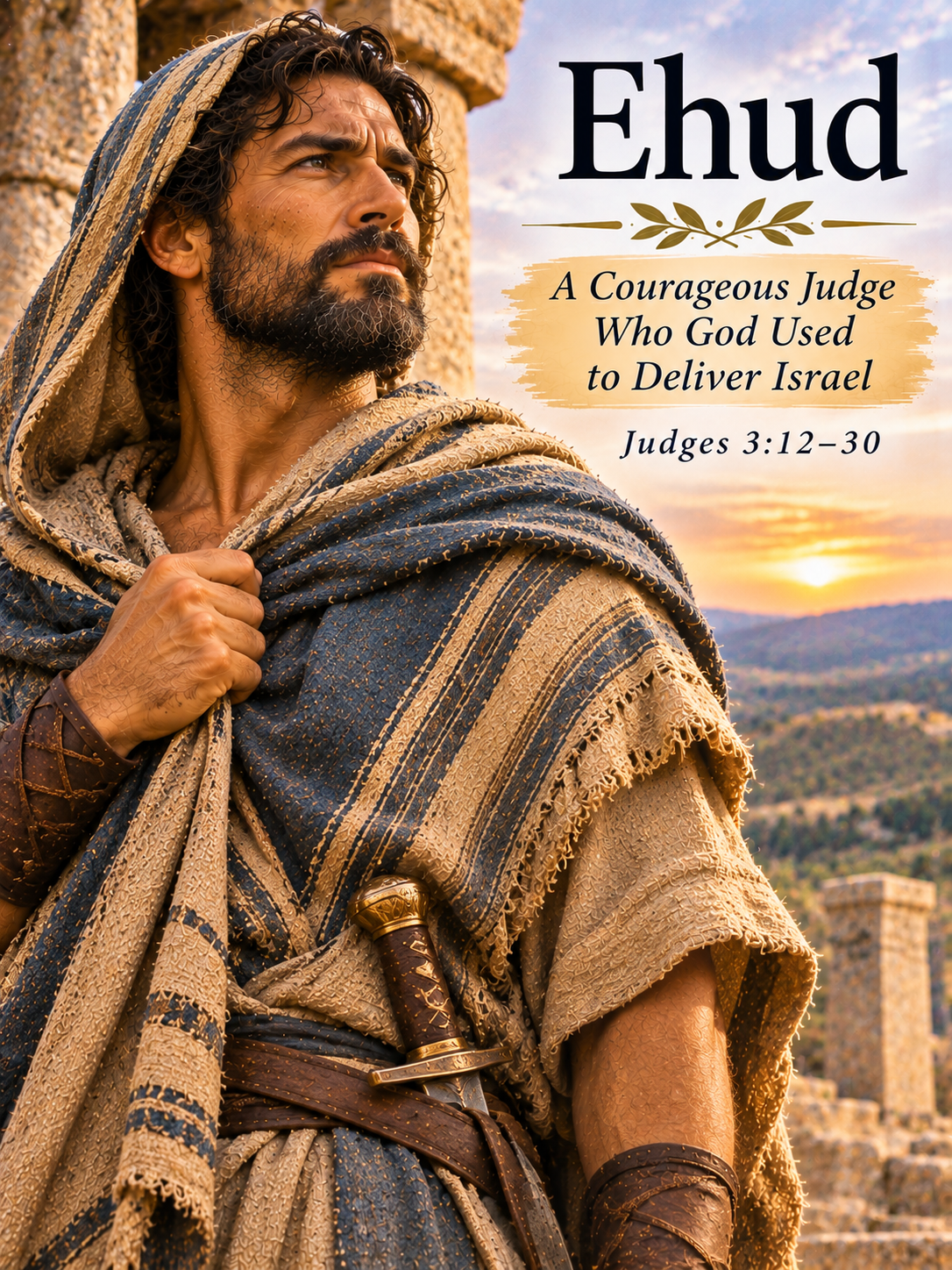
Have you ever looked at a situation and wondered how God could possibly bring good out of it?
Sometimes the circumstances around us seem impossible to change. The problem appears too big, the obstacles too strong, and the solution nowhere in sight. We may even wonder whether God is working at all. When we read the book of Judges, we discover that God often worked in ways His people could never have anticipated.
One of the most unusual examples is found in Judges 3:12–30. It is the story of Ehud, a left-handed man whom God used to deliver Israel from the oppression of Moab.
Ehud’s story includes political conflict, a surprising strategy, and a dramatic turning point in Israel’s history. It is not an account we should rush through. When we look carefully at the details, we discover an important truth: God is not limited by human expectations when He accomplishes His purposes.
Let’s open our Bibles and explore the story of Ehud, the unexpected deliverer.
The Background: Israel Turns Away From God Again
Before we meet Ehud, we need to understand what was happening in Israel.
Judges 3:12 begins with a familiar and troubling statement:
“The people of Israel again did what was evil in the sight of the LORD.”
The word again matters. The Israelites had already experienced God’s deliverance, yet they returned to disobedience. They turned away from the Lord, and their choices had consequences.
This time, God strengthened Eglon, king of Moab, against Israel. Eglon gathered the Ammonites and Amalekites, attacked Israel, and took possession of the City of Palms, generally identified with Jericho. The Israelites served Eglon for eighteen years.
Imagine living under the rule of a foreign king for nearly two decades. Their freedom was restricted, their circumstances were difficult, and they were subject to an oppressive power. Yet the story does not end with Israel’s suffering.
Judges 3:15 tells us:
“But when the people of Israel cried out to the LORD, the LORD raised up for them a deliverer.”
That deliverer was Ehud. Notice where the story places the emphasis. Israel cried out, and the Lord raised up someone to deliver them. God was the One who initiated the rescue. This pattern appears repeatedly throughout Judges. The people turn away from God, experience the consequences of their disobedience, cry out to Him, and receive a deliverer.
The cycle reveals both the seriousness of sin and the mercy of God. Israel’s repeated failures are sobering, but so is the Lord’s continued willingness to act on behalf of His people.
A question for reflection: Do you sometimes find yourself turning to God only when your circumstances become difficult? What would it look like to seek Him faithfully in seasons of both comfort and trouble?
God is worthy of our devotion in every season, not simply when we need His help.
1. God Used Someone Others Might Have Overlooked
Judges 3:15 introduces Ehud as the son of Gera, a Benjaminite who was left-handed.
Why does Scripture include that detail?
It is easy to read past it, assuming it is merely a description of his physical characteristics. But in the account that follows, Ehud’s left-handedness becomes important to the way events unfold.
Ehud belonged to the tribe of Benjamin. The name Benjamin is associated with the idea of the right hand or the son of the right hand, making the description of Ehud as left-handed particularly interesting. Some interpreters understand the Hebrew wording to suggest that his right hand was restricted, although the text is commonly translated as saying that he was left-handed.
We should be careful not to build an entire explanation around something Scripture does not explicitly tell us. What we can say with confidence is that the author draws attention to a characteristic that becomes significant in the narrative.
Ehud was not introduced as a mighty warrior with an impressive reputation. Instead, Scripture gives us a seemingly small detail that helps explain what happens next.
God used Ehud in a way that fit the circumstances of the story.
This reminds us that God’s work is not confined to the people we expect Him to use. The Lord is not dependent on outward appearances, human status, or the qualities that receive the most attention from others.
Throughout Scripture, God works through people whose lives challenge our assumptions.
David was the youngest son in his family when Samuel anointed him as king. Gideon described his clan as weak and himself as the least in his father’s house. The disciples included ordinary fishermen.
Their stories remind us to look beyond our assumptions about who is qualified to serve God.
This does not mean that every unusual characteristic is a special calling or that every overlooked person will have the same kind of role. Rather, it reminds us that God’s purposes are not limited by our expectations.
For your own study: What details does Scripture emphasize about Ehud? Why might the author have included them? What can you conclude from the passage, and what would be speculation?
Learning to distinguish observation from assumption is an important part of studying the Bible well.
2. Ehud’s Unusual Mission
After introducing Ehud, the passage tells us that the Israelites sent him with a tribute to Eglon, king of Moab.
Ehud made a double-edged sword, about a cubit long, and fastened it under his clothing against his right thigh.
He brought the tribute to Eglon, who is described as a very fat man. After delivering the tribute, Ehud sent away the people who had carried it.
Then he returned to the king.
In Judges 3:19, Ehud told Eglon that he had a secret message for him. The king sent his attendants away, and Ehud approached him while he was sitting alone in his private upper room.
Ehud then announced, “I have a message from God for you.”
What followed was a violent act that resulted in Eglon’s death. Ehud escaped, gathered the Israelites, and called them to follow him.
This is a difficult passage for modern readers. It is graphic, and we should not pretend otherwise.
It is also important not to turn Ehud’s actions into a general lesson that deception or violence is acceptable whenever someone believes a cause is righteous. The narrative describes a particular event in Israel’s history under God’s covenant dealings with His people. It does not give Christians permission to imitate Ehud’s methods or use this account to justify personal vengeance.
Our task is to understand what the passage says, why the events matter in the book of Judges, and how the account contributes to the larger biblical story.
The central emphasis of the passage is Israel’s deliverance from Moabite oppression.
God had raised up Ehud as a deliverer, and through the events described in the text, Israel’s oppressor was removed.
The story is unexpected, but the larger pattern is familiar: the Lord hears His people and acts to deliver them.
3. Deliverance Came From an Unexpected Direction
Imagine what an Israelite living under Moabite rule might have expected from a deliverer.
Perhaps someone would gather a large army, confront the enemy openly, and win a conventional military victory.
Instead, the account begins with a man sent to deliver tribute to the king.
The situation did not look like the beginning of a national rescue.
Yet God had raised up Ehud, and the events that followed changed Israel’s circumstances.
This is one of the striking features of the book of Judges. The Lord repeatedly works through people and circumstances that challenge ordinary expectations.
Gideon’s army would later be reduced to just three hundred men. Deborah would lead Israel alongside Barak. Samson’s story would unfold through a complicated life marked by both divine purpose and personal weakness.
The judges are not presented as flawless heroes. Their stories belong to a larger account of Israel’s recurring disobedience and God’s repeated interventions.
And this is where we need to pay attention.
The point is not that God will always deliver us through an unusual person or a surprising turn of events. Scripture does not promise that every difficult circumstance will end in immediate relief.
Rather, Ehud’s story reminds us that God is sovereign. He is not restricted to the solutions we can imagine, and His purposes do not depend on our ability to predict how He will work.
Sometimes we become so focused on how we believe God should answer a prayer that we overlook the ways He may already be working.
We may expect a dramatic change when He is calling us to take a faithful next step. We may look for an immediate answer when He is teaching us patience. We may assume a particular opportunity is the only way forward when another path opens.
We must always evaluate our expectations against Scripture rather than treating every unexpected development as a message from God.
But we can rest in the truth that our understanding is limited and His wisdom is not.
Reflection: Is there a situation in your life where you have decided in advance how God must work? What would it look like to bring that expectation before Him with humility and ask for wisdom to recognize the next faithful step?
4. Ehud Called Israel to Follow Him
After escaping from Eglon’s palace, Ehud returned to the hill country of Ephraim. He blew a trumpet and called the Israelites to follow him, declaring that the Lord had given their enemies, the Moabites, into their hand.
The people followed him, seized the fords of the Jordan against the Moabites, and prevented them from crossing.
Judges 3:29 reports that about ten thousand Moabites were struck down. The passage describes them as strong and able-bodied men, and it states that not a man escaped.
The result was decisive: Moab was subdued under Israel’s hand that day.
Verse 30 concludes that the land had rest for eighty years.
Eighty years is a significant period of peace in the narrative. After eighteen years of oppression, Israel experienced rest.
Notice the contrast between the beginning and end of the account.
At the beginning, Israel was under Moabite domination. At the end, Moab had been subdued, and the land was at rest.
The turning point was not Israel’s ability to escape its history of disobedience through human effort alone. The passage begins by telling us that the Lord raised up a deliverer.
Ehud played a significant role, but the story directs our attention to the Lord’s action on behalf of His people.
This is a distinction worth remembering as we study all the judges.
God used human leaders, but Israel’s ultimate hope could not rest in any one of them. The larger book repeatedly shows that the people continued to struggle with faithfulness to the Lord.
Their need was deeper than the removal of a foreign oppressor. They needed hearts that remained devoted to God.
5. What Ehud’s Story Teaches Us About God
Ehud’s account is unusual, but it offers several important lessons when we read it within the context of Judges.
God hears His people when they cry out
Israel had experienced eighteen years of oppression. When the people cried out to the Lord, He raised up a deliverer.
The passage reminds us that God is not indifferent to the suffering of His people. It also reminds us that Israel’s circumstances were connected to the nation’s disobedience, a specific feature of its covenant history that we should not automatically apply to every hardship people experience today.
When we suffer, we can bring our concerns to God honestly. We can examine our hearts, seek His wisdom, and trust His character without assuming that every difficulty is punishment for a particular sin.
God’s purposes exceed our expectations
Ehud’s story unfolds in an unexpected way. God’s work was not limited to the kind of deliverer someone might have anticipated.
We can learn to approach Scripture with humility, allowing the text to shape our understanding rather than forcing it into our assumptions.
God is the true source of deliverance
The passage identifies the Lord as the One who raised up Ehud. The judge was an instrument of deliverance, but God remained the central figure in Israel’s story. This pattern continues throughout Scripture. Human leaders have limitations, and even the most impressive people cannot provide the ultimate answer to humanity’s deepest need.
Peace under a judge was not the end of Israel’s story
The eighty years of rest were a remarkable change in circumstances, but the book of Judges continues beyond Ehud’s lifetime. The recurring cycle of disobedience and deliverance reveals Israel’s need for lasting faithfulness and righteous leadership.
For Christians, the whole biblical story ultimately points us to Jesus Christ. Jesus does not merely provide temporary relief from an earthly oppressor; He came to save His people from their sins. Through His death and resurrection, He accomplished the redemption we could never accomplish for ourselves.
Ehud’s account is not a direct prediction of every detail of Christ’s life. It is part of the wider biblical story that reveals humanity’s need for deliverance and God’s unfolding plan of redemption.
Our deepest hope is not in an earthly judge, political leader, or unexpected solution. Our hope is in the Lord.
Bring Ehud’s Story Into Your Bible Journal
I love how Bible journaling can give us another way to engage with Scripture. We can record an observation, highlight a key verse, write a question in the margin, or create a page that helps us remember what we have learned.
Ehud’s story offers several possibilities for a journaling page.
You might focus on Judges 3:15 and the truth that the Lord raised up a deliverer. You could also use the conclusion of the passage in Judges 3:30 to record the outcome of the conflict and the eighty years of rest.
As you create your page, let the biblical text remain at the center. The artwork should support your engagement with Scripture, not replace the careful reading and reflection that help us understand it.
If you enjoy using illustrations and decorative elements in your Bible study, I created an Ehud Bible Journaling Clip Art Kit to help you explore this unusual account creatively. You can use the kit in your journaling Bible, a Scripture notebook, or a printed Bible study page.
Purchase the Ehud Bible Journaling Clip Art Kit here.
I hope it gives you another way to slow down, reflect on God’s Word, and remember what you have discovered in this passage.
Study Ehud’s Story for Yourself
One of the best ways to grow in your understanding of Scripture is to slow down and examine the passage for yourself before relying on someone else’s explanation.
Read Judges 3:12–30. If you have time, read Judges 2:6–23 first so you can see the recurring pattern that provides the background for Ehud’s story.
Then work through these questions:
Behold the Text — What do you observe?
- What does Judges 3:12 say the Israelites did again?
- How long did Israel serve Eglon?
- What details does the passage give us about Ehud?
- What sequence of events follows Ehud’s delivery of the tribute?
- What changed for Israel by the end of the passage?
Investigate the Meaning — What does it mean?
- Why is it significant that the Lord raised up Ehud as a deliverer?
- What role does Ehud’s left-handedness play in the narrative?
- How does the account contribute to the recurring cycle described in Judges?
- What does the passage emphasize about the Lord’s role in Israel’s deliverance?
Embrace the Truth — How should you respond?
- What does this account teach you about God’s sovereignty?
- Is there an assumption you need to hold more loosely as you seek the Lord’s wisdom?
- How can you remain faithful to God even when you cannot see how a difficult situation will unfold?
As you answer, pay attention to the difference between what the text explicitly states, what you can reasonably conclude, and what you might simply be imagining. That distinction is essential to sound Bible study.
A Final Thought: God Is Not Limited by Our Expectations
Ehud’s story is one of the most unusual accounts in the book of Judges. It includes details that may surprise us and events that require careful thought. But at its heart, the passage tells us that Israel’s deliverance began with the Lord raising up someone to rescue His people.
We may not always understand how God works, and we should never assume that every unexpected event carries a particular divine message. But we can study His Word with confidence that He is sovereign, faithful, and worthy of our trust.
The next time you encounter an unfamiliar name or an unusual story in Scripture, resist the temptation to skim over it. Slow down. Observe the details. Ask questions. Seek to understand the passage in context.
You may discover that even a story you would not have chosen to read first has something important to teach you about the God who stands at the center of Scripture.
Happy studying and happy journaling!
Mary
Mary’s Musings
Let me know what you think.